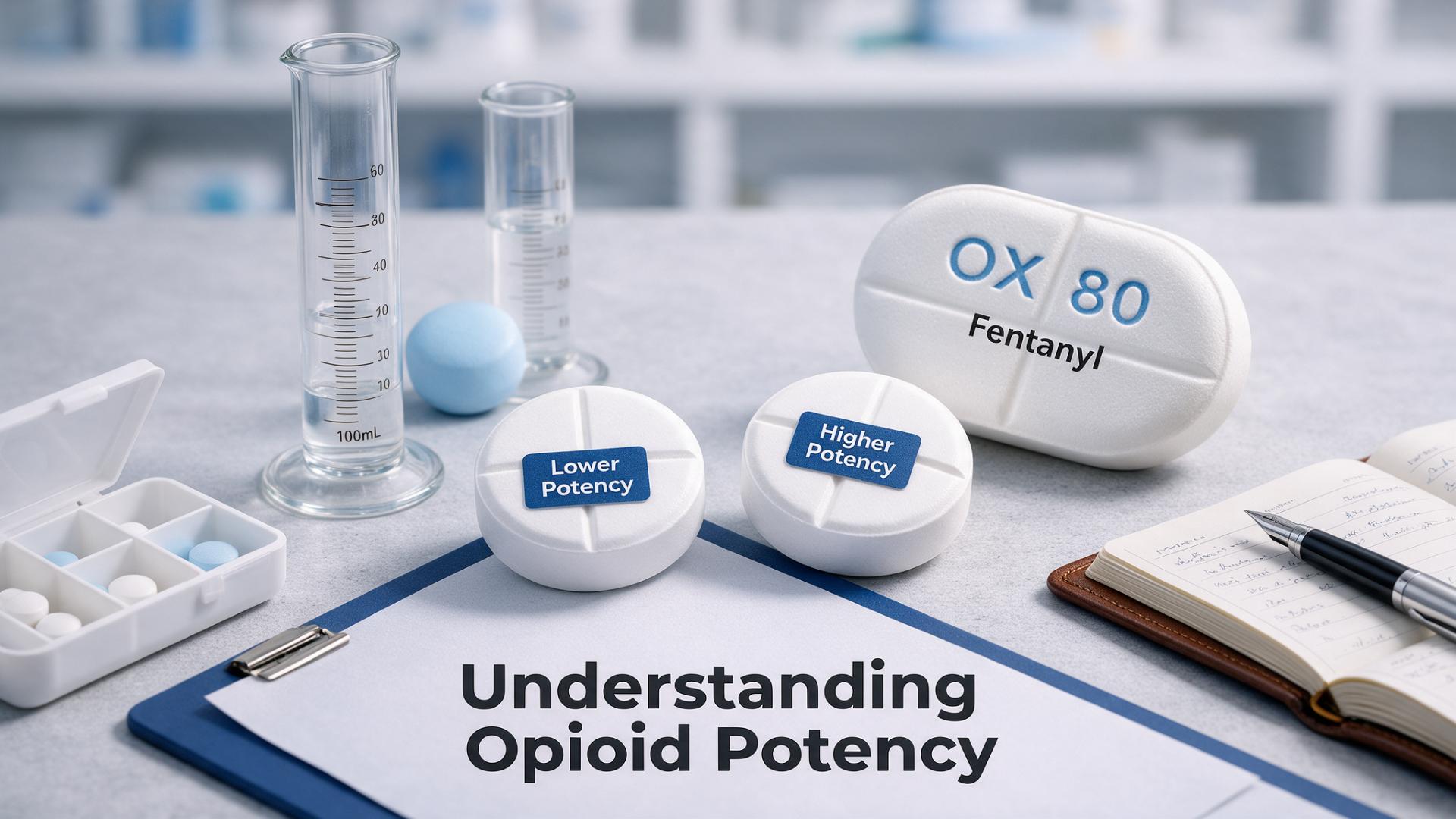
Understanding Opioid Potency: What Patients and Families Should Know
When a prescription changes, or a relative is sent home with a new painkiller, families often ask a simple question. Which one is stronger? The honest answer is more nuanced than a ranking, and understanding why helps people use these medicines more safely.
Why the question comes up
People compare opioids because they want to know how worried to be. A pill named on a bottle can sound mild or severe depending on what the neighbor said about it. The comparison most often asked about involves oxycodone and hydrocodone, the opioids in two of the most widely prescribed painkillers.
The answer to is Percocet stronger than hydrocodone is addressed in a short article from Northwoods Haven Recovery. It explains that Percocet combines oxycodone with acetaminophen, that hydrocodone is commonly combined with acetaminophen in products such as Vicodin and Norco, and that oxycodone is slightly stronger on a milligram-for-milligram basis. It adds that both are effective pain relievers with similar benefits and risks, and that some patients feel oxycodone works faster while others find hydrocodone lasts a bit longer.
Slightly stronger per milligram does not mean one is the safe choice and the other the dangerous one. It means the doses are not interchangeable. A clinician who prescribes one product has chosen a dose with that product's strength in mind.
How clinicians compare opioids
Prescribers use a common yardstick called morphine milligram equivalents, or MME. The CDC clinical practice guideline for prescribing opioids for pain provides conversion factors that translate a daily dose of each opioid into the amount of morphine with comparable potency. In that scheme hydrocodone and morphine have a factor of 1, oxycodone 1.5, oxymorphone 3, hydromorphone 4 and codeine 0.15, with higher factors for methadone and a separate factor for fentanyl patches.
So 20 milligrams of oxycodone counts as 30 MME, while 20 milligrams of hydrocodone counts as 20 MME. The numbers help prescribers judge total daily exposure and decide when extra caution or naloxone is warranted.
The same guideline asks clinicians to prescribe immediate-release rather than long-acting formulations when starting opioids, to use the lowest effective dose and to prescribe no longer than the expected duration of pain severe enough to need opioids. Conversion factors are estimates, and they are not intended for decisions about medications used to treat opioid use disorder. Another reason the scale exists is risk tracking. The guideline notes that the risk of overdose rises as daily dose increases, so a total that climbs past certain thresholds is a prompt to reassess whether the benefit still outweighs the harm, to consider naloxone and to talk about tapering. Patients can ask their prescriber what their daily MME total is, a question that most clinicians can answer quickly.
Why potency is not the whole story
Strength per milligram is one of several factors. How a person responds depends on the dose, how long they have taken opioids, their body size and liver function, and what else they take. Someone who has used opioids for weeks needs more of the drug to feel the same effect, while someone who has not used any for a while can be overwhelmed by a small amount.
Combination products add another risk. Percocet and many hydrocodone tablets contain acetaminophen, and taking more tablets to chase pain relief raises the acetaminophen dose along with the opioid dose. Liver injury is a real risk with excess acetaminophen, so every other product with acetaminophen, including cold remedies, needs to be counted.
Because of all this, switching between painkillers without a prescriber's guidance is a mistake, even when the labels seem to imply a simple equivalence. Equivalence tables are for clinicians who also factor in tolerance and cross-tolerance.
Fentanyl changes the stakes
Prescription opioids come with labeled doses. Illicit supplies do not, and fentanyl now contaminates much of the street supply. Northwoods Haven describes fentanyl as 50 to 100 times stronger than morphine, and a quantity too small to see can be enough to stop breathing.
That is why a pill from a friend or an unmarked tablet is a very different risk from a prescription. Counterfeit tablets made to look like oxycodone or hydrocodone have been found to contain fentanyl, and there is no way to judge a dose by appearance. Even people who have used opioids for years can misjudge the strength of a tablet that did not come from a pharmacy.
Naloxone reverses an opioid overdose and is available at pharmacies in Minnesota. Households with any opioid in the home, prescribed or otherwise, benefit from having it on hand and from knowing how to use it. Pharmacists can show how the nasal spray works, and keeping it near where medicines are stored makes it easy to find in an emergency.
What families can do
Start with the prescriber and the pharmacist. Ask what the medication is, how long it should be used and what to do when pain eases. Keep a written list of all medicines, including supplements, and share it at every visit.
Store opioids where visitors and children cannot reach them, preferably locked, and dispose of leftovers through a take-back program or pharmacy kiosk. Watch for changes such as early refills, drowsiness at odd hours or hiding pills, and speak about them with care rather than accusation.
If use has moved beyond control, outpatient opioid treatment is available, and the conversation can begin with a call to a program or a chemical use assessment.
Talk openly with teenagers and young adults as well. Many first exposures happen through pills taken from a family medicine cabinet or shared at a party, and a calm conversation about counterfeit tablets and fentanyl does more than a lecture. Explain that a tablet's appearance cannot tell you what it contains.